Learning HQ

At HQ, we don't just provide software - we partner with clinics in the daily realities of running a high-volume spay/neuter program. Our system is built to answer questions and smooth out the operational bumps that come with managing patient flow, medical records, and financial tracking. We like to think of ourselves as shoulder to shoulder with your team, helping you streamline processes so staff can focus on what matters most: caring for animals and serving the community. From the first login to the busiest clinic day, we're right there with you, providing tools, guidance, and support every step of the way.
Start with the Manual
This manual should always be your first step when looking for answers.
This manual is designed to guide you through every aspect of Clinic HQ — from the first steps of getting set up to advanced tools that power your clinic's efficiency.
Whether you're just beginning your journey with Clinic HQ or exploring the more powerful features, this guide is here to walk alongside you. It's built to be:
- Easy to navigate with a clear, structured layout.
- Searchable so you can quickly find answers when you need them most.
HQ University
For more in-depth information, HQ University offers guides and tutorials through our online learning platform.
Discovering HQ University
Whether you're a brand-new clinic or have been with Clinic HQ for years, the training videos in Clinic HQ University are essential for key administrative and medical team members. These courses help your team fully understand the ins-and-outs of the software.
HQ University provides comprehensive training and education for veterinary professionals looking to integrate cloud-based software into spay/neuter clinics. Our mission is to improve the efficiency, safety, and overall quality of services through innovative technology and education.
What You Can Expect
- Comprehensive training on HQ's cloud-based software.
- Expert guidance on integrating HQ into your clinic.
- Ongoing support and updates to maximize value.
- A community of like-minded veterinary professionals.
How to Access Training Courses
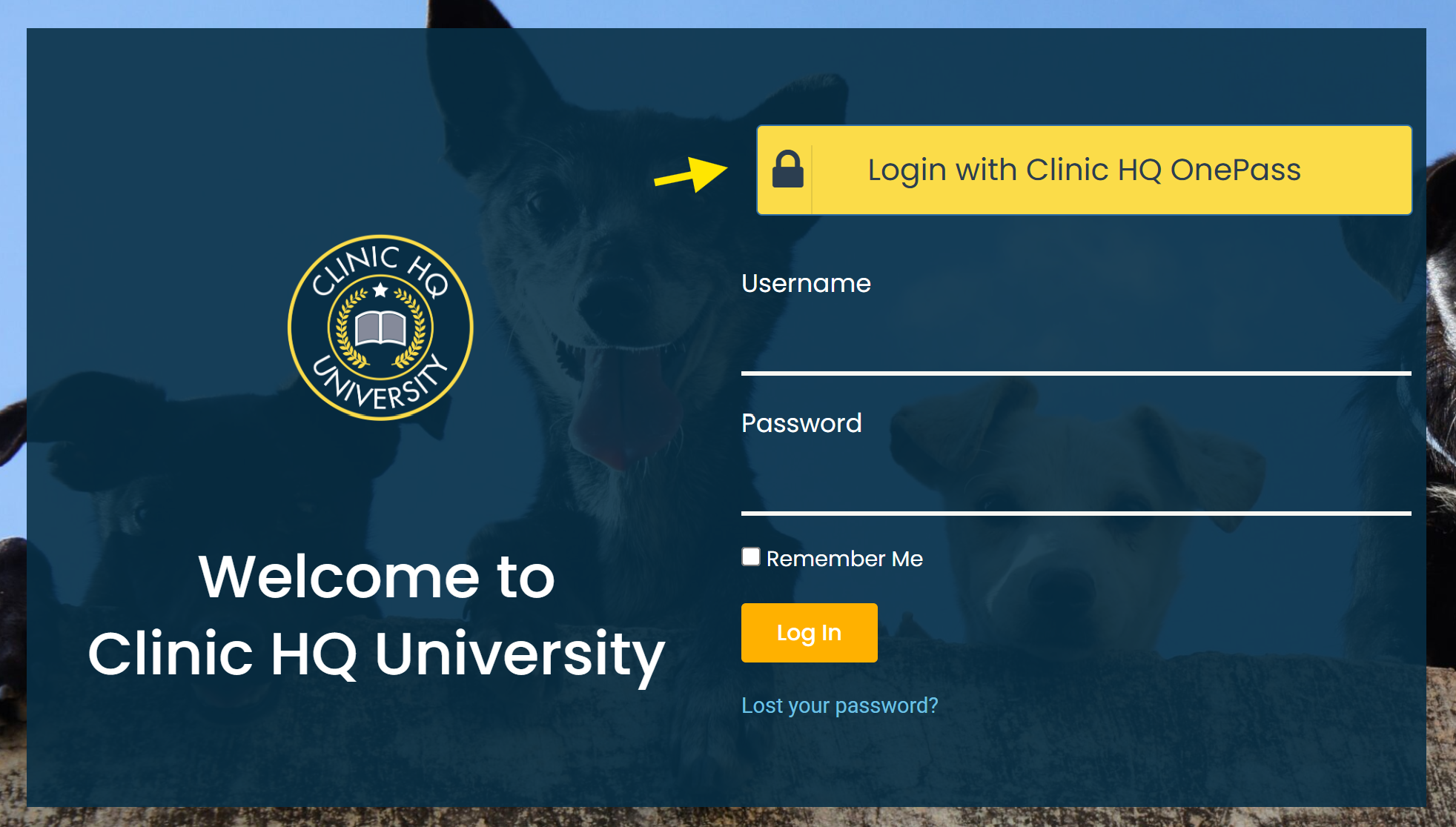
- Go to HQ University.
- Click Course Login in the top navigation menu.
- Select Login with Clinic HQ OnePass.
- If you're already signed in, you won't need to enter credentials again.
- Once logged in, click My Courses.
- Complete as many of the free HQ Setup Courses as you'd like — and get HQ Certified!
Clinic HQ Setup Course
- Each clinic should designate at least one administrator to complete this course.
- The Setup Course covers every screen in HQ, including detailed tools and advanced features.
- It's ideal for clinics that want to leverage all of HQ's capabilities.
Clinic HQ Go-Live Courses
- Admin Course – Covers administration basics through advanced tasks such as making appointments and managing payment options.
- Medical Course – Guides the medical team through Patient Flow, drug logging, medical records, Idexx, and rechecks.
HQ's Top Tools
- Watch these videos on HQ's most powerful features.
- Discover tools you may not be using yet — all included in your subscription.
HQ Perks
Discover the benefits of being a Clinic HQ clinic HERE!
Training Clinic
At HQ, every user has access to their own personal training site. This dedicated space is designed to give you the freedom to explore without any worries. You can test out new features, enter sample data, and experiment with different workflows — without the risk of affecting your real clinic site.
Each training clinic comes pre-loaded with helpful templates, drug logs, and other resources to get you started quickly. However, you're not limited to what's provided — you can easily upload your own files, customize settings, and make it feel like your real clinic environment.
Think of this training clinic as your sandbox, a safe place where you can learn, practice, and build confidence in using HQ.
Access Your Own Personal Training Clinic
To access your training clinic, navigate to the Help & Support menu, then click Visit Training Site. Team members can safely practice tasks such as:
- Making appointments
- Drawing and wasting drugs
- Exploring different settings
- Testing out features and workflows
All of this can be done without liability.
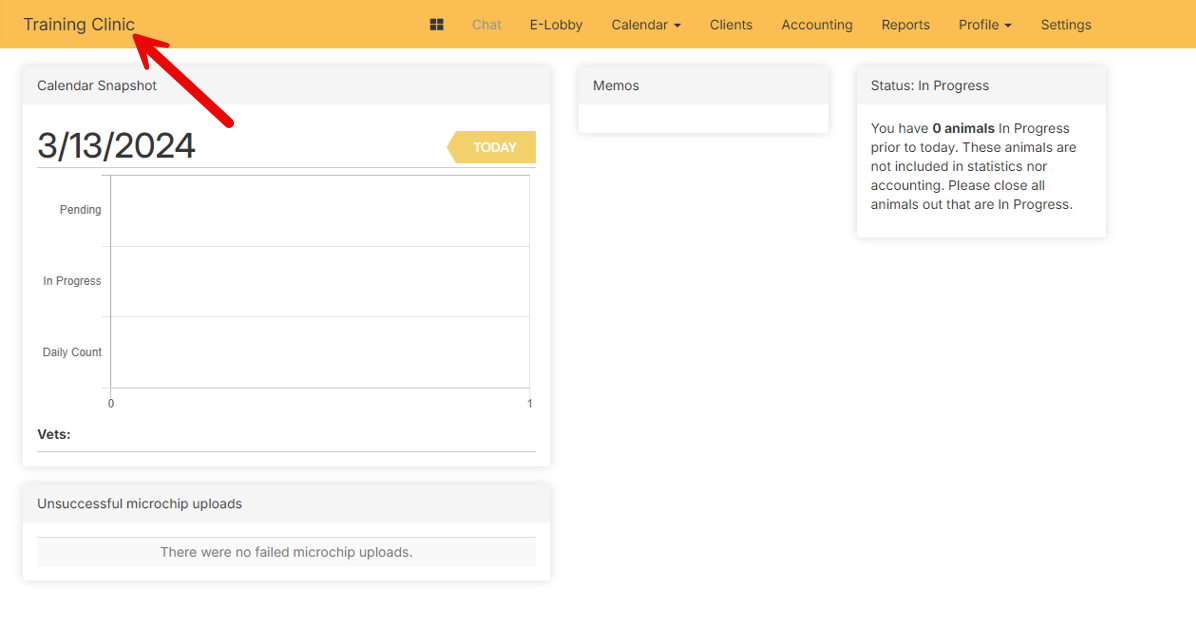
The training site looks exactly like your clinic's own HQ site, with two key differences:
- The name Training Clinic appears in the upper-left corner instead of your clinic's name.
- The site is bordered in yellow, instead of the standard CHQ Blue.
New Employee Training
Clinics are responsible for onboarding and training new employees. Staff should be guided to the Manual and HQ University for additional support and reference throughout the process.
Quizzes — Materials for Managers
We wanted to provide you with tools you can customize for staff training. The most effective way to know whether an employee understands HQ is to quiz them. Google Forms has a free quiz feature that works great for this purpose.
To get off and running, we've created an HQ Quiz for you to copy and edit as desired.
Click HERE to copy this quiz to your own personal Google Drive.
Note: Be sure to use your own link from the copied Google Form when sending this quiz to your employee. Do not send them this link, as it simply allows you to transfer a copy of the quiz.
Getting Help
If you have scoured the manual and still can't find what you are looking for, please reach out to Fin, our amazing AI agent. He will be happy to help you quickly find answers, explain processes, and guide you through common tasks. If your question isn't answered, Fin will route you to our tech support team.
Check the status of your pending requests:
To check the status:
- Go to the Help menu.
- At the bottom of the page, you'll see all open and solved tickets submitted under your profile.

Status Tags
- New – Has not yet been reviewed by staff.
- Open – An agent is actively working
- Pending – An agent is waiting for your response. (If no reply is received within two days, the ticket will close.)
- On-Hold – Awaiting an update from someone outside the help desk team.
HQ's Status Page
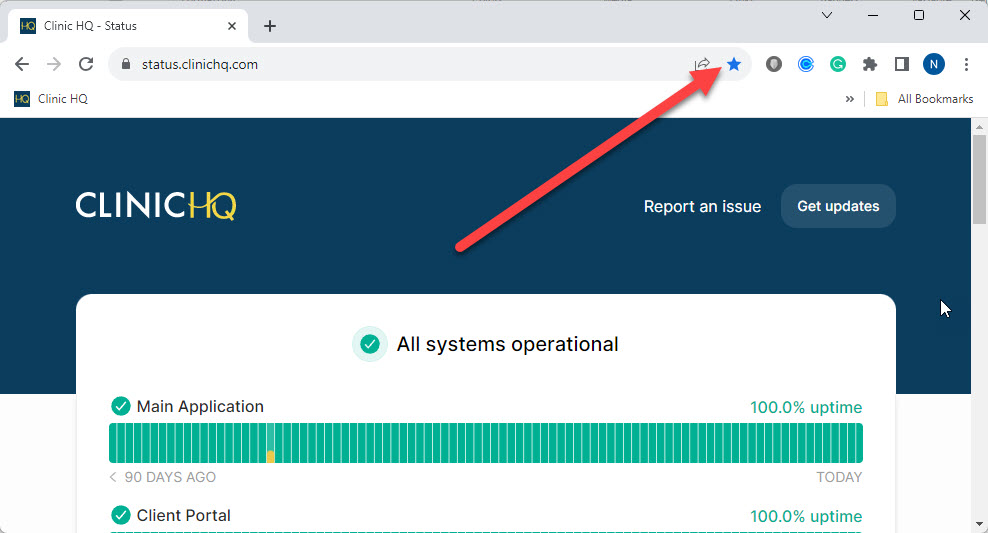
We recommend saving the following web page as a bookmark in your browser. This website will let you know if HQ is experiencing any outages or issues.
Clinic HQ Status (Issues & Outages): https://status.clinichq.com/
What HQ Does Not Provide Assistance On
We aim to provide all the information you need to run your clinic smoothly with Clinic HQ. At the same time, we want to be clear about the areas we are unable to troubleshoot or support.
Dymo Printers
For printer issues, please refer to our Troubleshooting Page.
Dymo Support Contact Information
- Phone: 877-724-8324
- Hours: Monday–Friday, 9:00 AM – 5:00 PM EST
- Reach out to Dymo directly, here
Transactions Processed Directly Through MX Merchant
Please note that we cannot adjust or correct refunds in Clinic HQ if they were processed directly through MX Merchant. We also no longer provide support for individual transactions handled in this way.
For guidance on processing refunds:
- See the Refunds Section for instructions within Clinic HQ.
⚠ Important: Clinic HQ does not provide support for:
- Dymo label writers.
- Transactions processed directly through MX Merchant.
The Library
General Protocols:
High-Quality, High-Volume Spay and Neuter and Other Shelter Surgeries by Sara White
High-Quality, High-Volume Spay-Neuter: Access to care and the challenge to private practitioners by Phillip A Bushby
Histologic evaluation of parovarian nodules in the cat by Meghann L Haase-Berglund
Shelter Medicine for Veterinarians and Staff by Lila Miller and Stephen Zawistowski
The Association of Shelter Veterinarians’ 2016 Veterinary Medical Care Guidelines for Spay-Neuter Programs by Brenda Griffin
The role of private practitioners in reducing numbers of homeless dogs and cats and shelter euthanasia rates by Sam C. Phillips, Zarah Hedge, Jose M. Peralta
Prevention of fetal suffering during ovariohysterectomy of pregnant animals. by Sara C White
Characteristics of clients and animals served by high-volume, stationary, nonprofit spay-neuter clinics. by Sara C White
Onset of sentience: The potential for suffering in fetal and newborn farm animals by David J D Mellor
Effects of peripheral active warming and passive insulation on core body temperature during feline ovariohysterectomy: a multi-arm randomized clinical trial by Rachael E Kreisler , Lauren J MacDonald and Jeffrey W Norris
Anesthetic Protocols:
1. ********General Information on Veterinary Anesthesia Protocols
Anesthesia and Pain Management of Shelter Populations by Andrea L. Looney.
High-Quality, High-Volume Spay and Neuter and Other Shelter Surgeries edited by Sara White
HOW SAFE IS ANESTHESIA FOR DOGS AND CATS? by Sheilah A Robertson
Perioperative mortality in cats and dogs undergoing spay or castration at a high-volume clinic by J.K. Levy, K.M. Bard, S.J. Tucker, P.D. Diskant, P.A. Dingman
Risk factors for anaesthetic-related death in cats: results from the confidential enquiry into perioperative small animal fatalities (CEPSAF) by D. C. Brodbelt, D. U. Pfeiffer, L. E. Young, J. L. N. Wood
Topics in companion animal medicine by Jeff C Ko
2. ********Canine Anesthetic Protocols
Anaesthetic induction and recovery characteristics of a diazepam-ketamine combination compared with propofol in dogs by Jacques P. Ferreira, T. Brighton Dzikiti, Gareth E. Zeiler, Roxanne Buck, Bruce Nevill, Bruce Gummow, Lynette Bester
Findings from Washington State University Provides New Data on Veterinary Medicine [Incidence of and risk factors for postoperative regurgitation and vomiting in dogs: 244 cases (2000-2012)]
Effects of acepromazine- morphine and acepromazine- methadone premedication on the minimum alveolar concentration of isoflurane in dogs by Eduardo R Monteiro, Karina Coelho, Thais F Bressan, Clarissa R Simoes & Betania S Monteiro
Hemodynamic influence of acepromazine or dexmedetomidine premedication in isoflurane-anesthetized dogs by Stefania C. Grasso
Use of trazodone to facilitate postsurgical confinement in dogs by Margaret E. Gruen
Multivariable analysis of anesthetic factors associated with time to extubation in dogs by Stephanie S Kleine
3. ********Feline Anesthetic Protocols
AAFP Feline Anesthesia Guidelines by Sheilah A Robertson.
Use of single-dose oral gabapentin to attenuate fear responses in cage-trap confined community cats: a double-blind, placebo-controlled field trial by Katherine E Pankratz
The effect of dexmedetomidine against oxidative and tubular damage induced by renal ischemia reperfusion in rats by Murat Cakir, Alaadin Polat, Suat Tekin, Nigar Vardi, Elif Taslidere, Zeynep Rumeysa Duran, and Kevser Tanbek
Prepubertal gonadectomy in cats: different injectable anaesthetic combinations and comparison with gonadectomy at traditional age by Nathalie Porters
Evaluation of the sedative and cardiorespiratory effects of dexmedetomidine, dexmedetomidine-butorphanol, and dexmedetomidine-ketamine in cats by André L Selmi
Evaluation of the clinical efficacy and safety of dexmedetomidine or medetomidine in cats and their reversal with atipamezole by Mikael Granholm, Brett C McKusick, Fia C Westerholm & John C Aspegren.
Effects of a single preappointment dose of gabapentin on signs of stress in cats during transportation and veterinary examination by Karen A. van Haaften, Lauren R. Eichstadt Forsythe, Elizabeth A. Stelow, Melissa J. Bain
Efficacy of a single dose of trazodone hydrochloride given to cats prior to veterinary visits to reduce signs of transport- and examination-related anxiety. by Brenda J Stevens
4. ********Anesthesia and Fasting
Incidence of and risk factors for postoperative regurgitation and vomiting in dogs: 244 cases (2000-2012) by John A Davies
Preoperative Fasting: An Outdated Concept? by J. Diks
Proper Timing for Preanesthestic Fasting by Jonathan Miller, DVM, MS, DACVS
The Association of Shelter Veterinarians’ 2016 Veterinary Medical Care Guidelines for Spay-Neuter Programs by Brenda Griffin et. al.
The effect of pre-anaesthetic fasting time and type of food on gastric content volume and acidity in dogs by Ioannis Savvas
5. ********Anesthesia and NSAID Use
Changes in platelet function, hemostasis, and prostaglandin expression after treatment with nonsteroidal anti-inflammatory drugs with various cyclooxygenase selectivities in dogs by Benjamin M. Brainard, VMD; Craig P. Meredith; Mary Beth Callan, VMD; Steven C. Budsberg, DVM, MS;Francis S. Shofer, PhD; Bernd Driessen, DVM, Dr med vet; Cynthia M. Otto, DVM, P
Comparison of injectable robenacoxib versus meloxicam for peri-operative use in cats: results ofa randomised clinical trial by Masatoshi Kamata
Effects of meloxicam on the haemostatic profile of dogs undergoing orthopaedic surgery by G. M. Kazakos, L. G. Papazoglou, T. Rallis, G. Tsimopoulos, K. Adamama-Moraitou, A. Tea
Evaluation of glomerular filtration rate in cats with reduced renal mass and administered meloxicam and acetylsalicylic acid by Kathryn K. Surdyk, DVM, PhD; Cathy A. Brown, VMD, PhD; Scott A. Brown, VMD, PhD
Evaluation of subcutaneous and oral administration of robenacoxib and meloxicam for the treatment of acute pain and inflammation associated with orthopedic surgery in dogs by Philippe Gruet, DVM; Wolfgang Seewald, PhD; Jonathan N. King, BVSc, PhD
Involvement of inflammation in severe post-operative pain demonstrated by pre-surgical and post-surgical treatment with piroxicam and ketorolac by Isami Fujita, Takako Okumura, Ayano Sakakibara and Yasuhiro Kita
Robenacoxib versus meloxicam for the control of peri-operative pain and inflammation associated with orthopaedic surgery in cats: a randomised clinical trial by Cindy Speranza, Vincent Schmid, Jerome M Giraudel, Wolfgang Seewald and Jonathan N King
A retrospective analysis of the effects of meloxicam on the longevity of aged cats with and withoutovert chronic kidney disease. by Richard A Gowan
Efficacy of tolfenamic acid and meloxicam in the control of postoperative pain following ovariohysterectomy in the cat by Javier Benito-de-la-Víbora
Community Cats:
2020 AAFP Feline Retrovirus Testing and Management Guidelines by Susan Little
Alley Cat Allies: Advocacy Toolkit
Humane strategies for controlling feral cat populations. by Julie K Levy
FeLV Research
Feline Retrovirus Management Guidelines
Prevalence of feline leukemia virus infection and serum antibodies against feline immunodeficiency virus in unowned free-roaming cats by Irene T. Lee, Julie K. Levy, Shawn P. Gorman, P. Cynda Crawford, Margaret R. Slate
Surgical Techniques:
This link will take you to a collection of research on surgical procedures and techniques for veterinary clinics.
A comparison of 2 different suture patterns for skin closure of canine ovariohysterectomy by Anne Sylvestre, Jeff Wilson, Jonathan Hare
ALREADY BEEN SPAYED? ALREADY BEEN NEUTERED? by Brenda Griffin, DVM, MS, DACVIM
Choice of Suture Pattern for Linea Alba Closure by Chrissy Roberts
Determining the optimal age for gonadectomy of dogs and cats by Margaret V. Root Kustritz
Scrotal Approach to Canine Orchiectomy by Brian A. DiGangi, Matthew Johnson, Natalie Isaza
Outcomes of elective gonadectomy procedures performed on dogs and cats by veterinary students and shelter veterinarians in a shelter environment. by Rachael E Kreisler
Use of an inguinal approach adapted from equine surgery for cryptorchidectomy in dogs and cats: 26 cases (1999-2010). by Robert R Steckel
Pedicle ties provide a rapid and safe method for feline ovariohysterectomy. by Kirk P Miller
Guidelines
The ASPCA Spay/Neuter Library
Access the library here: https://www.aspcapro.org/training-spayneuter-alliance-training/spayneuter-library
This is a fantastic library covering all aspects of clinic management.
Spay/Neuter Protocols
And these are not just the guides we've created! Here is a journal article from the American Veterinary Medical Association on spay/neuter guidelines titled "The Association of Shelter Veterinarians’ 2016 Veterinary Medical Care Guidelines for Spay-Neuter Programs
"Shelter Medicine for Veterinarians and Staff, Second Edition, 2013 Editors Lila Miller, BS, DVM Stephen Zawistowski, PhD, CAAB "
Case Studies
Better Vaccine Clinics with Clinic HQ
This case study was done in Brownsville, Texas, at a large vaccine clinic. View slideshow here
Reservation Clinics
The Hopi Nation held a two-day spay/neuter clinic and a walk-in vaccine clinic at the Tewa Community Center in Polacca, Arizona. The goal was to see if people would sign up online and if they would pre-sign the consent forms.
Ninety-three dogs were spayed/neutered and vaccinated, plus another ninety animals vaccinated.
View the slideshow here
Here is our research on spay/neuter clinic protocols.
Training Videos
Whether you are a new clinic or you have been with Clinic HQ for some time, these course training videos are essential for key administrative team members to watch in order to best understand the ins and outs of the software.
Clinic HQ Setup Course
This would be ideal for any clinic that feels they would like to leverage all the tools HQ has to offer. It goes through every screen in Setup and gets deep into the details and nuances of the tools available. If you suspect your clinic may not be getting everything out of HQ that is available, why not send someone to take this free course?
Clinic HQ Go Live Courses
We have two Go-Live Courses at university.clinichq.com that all onboarding clinics and new staff members would benefit from taking! The first is our HQ Go Live: Admin course. This course takes your team through administration duties starting with the basics and moving into making appointments and payment options. The second course is our HQ Go Live: Medical course which takes your medical team through Patient flow and drug logging, medical records, Idexx, and rechecks.
Here is a link to all of our current courses: Clinic HQ University
HQ's Top Tools
Watch these videos that discuss how to use the top features in Clinic HQ. Discover the awesome tools your clinic might be missing out on. Al clinics have access to these tools included in your subscription. The videos are ale a great teaching resource.